
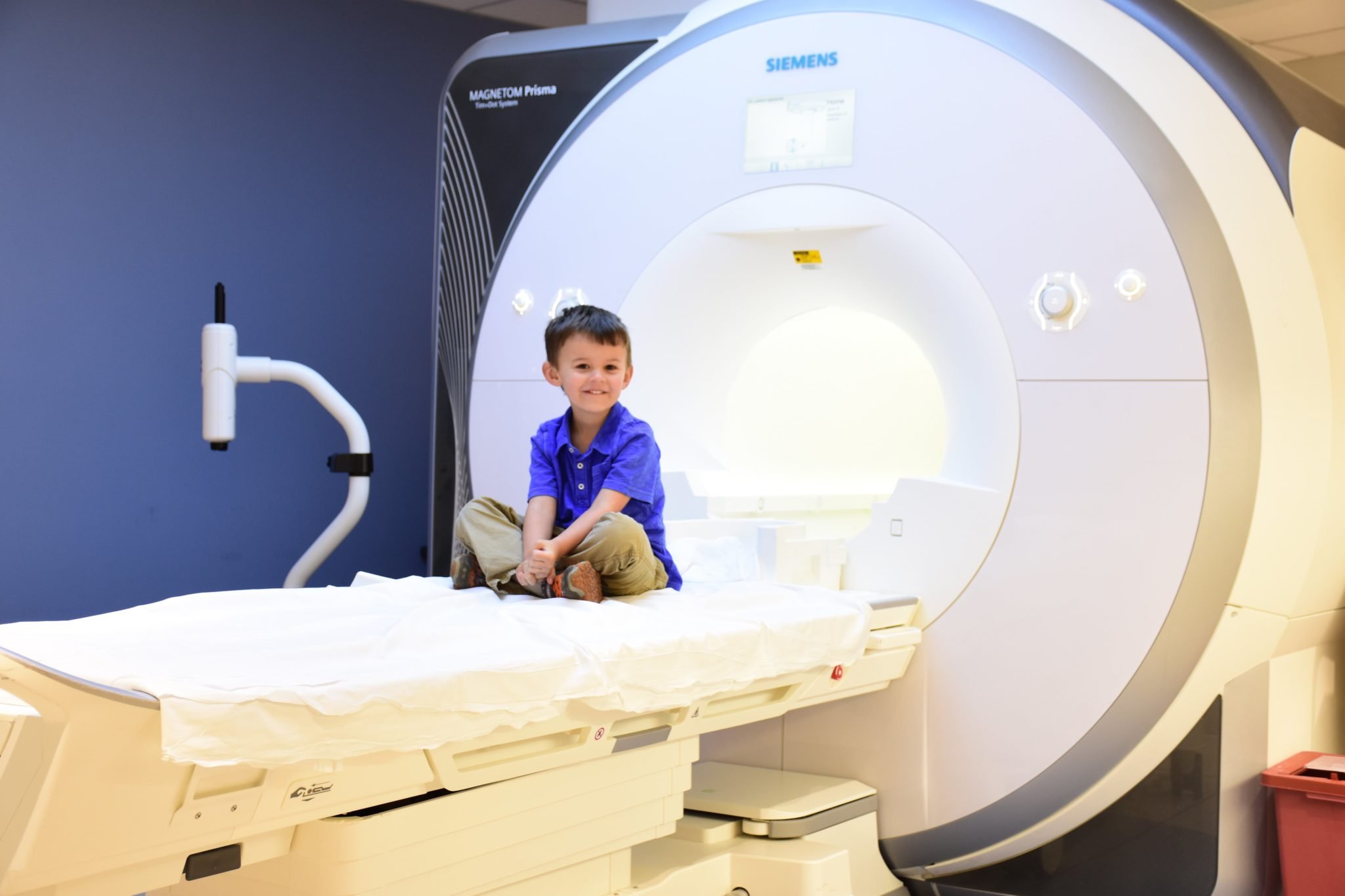
Magnetic Resonance Imaging
Neural responsivity to social rewards in autistic female youth (2020)
Authors: Katherine E. Lawrence, Leanna M. Hernandez, Jeffrey Eilbott, Allison Jack, Elizabeth Aylward, Nadine Gaab, John D. Van Horn, Raphael A. Bernier, Daniel H. Geschwind, James C. McPartland, Charles A. Nelson, Sara J. Webb, Kevin A. Pelphrey, Susan Y. Bookheimer and Mirella Dapretto on behalf of the GENDAAR Consortium
Summary:
This study investigates how girls with autism spectrum disorder (ASD) respond to social rewards compared to boys with ASD and typically developing peers. The researchers used functional magnetic resonance imaging (fMRI), which is a type of brain scan that shows which parts of the brain are active at a given time, to study brain activity in children and adolescents aged 8-17. They found that autistic girls show increased brain activity in response to social rewards, such as smiling faces, compared to both boys with ASD and typically developing girls. This increased activity was in areas of the brain involved in reward processing and recognizing important signals from the environment, like the nucleus accumbens and anterior insula. This is different from boys with ASD, who generally show reduced brain activity in these areas in response to social rewards. These findings highlight the importance of considering the differences between sexes in autism research to better understand how the condition presents in different people and can be best supported.
Authors: Kaitlin K. Cummings, Katherine E. Lawrence, Leanna M. Hernandez, Emily T. Wood, Susan Y. Bookheimer, Mirella Dapretto, and Shulamite A. Green
Summary:
Individuals with autism spectrum disorder (ASD) are much more likely to also experience intense reactions to sensory stimuli, also known as sensory over-responsivity (SOR). Most past research on SOR has been focused on males, so little is known about SOR in females with ASD. This study used brain imaging techniques to examine the salience network, which is the part of the brain that helps you notice and focus on the most important things around you. The research group consisted of boys and girls with ASD between the ages of 8 and 17 years old. While there were no differences in SOR symptoms between girls and boys, there were differences in brain connectivity associated with these symptoms. This suggests that girls and boys process sensory information in different ways. These findings highlight how important it is to consider sex differences in autism research, as they may have different experiences and benefit from different types of support.
Unsupervised Dimensionality Reduction Techniques for the Assessment of ASD Biomarkers (2024)
Authors: Zachary Jacokes, Ian Adoremos, Arham Rameez Hussain, Benjamin T. Newman, Kevin A. Pelphrey, John Darrell Van Horn, the ACE GENDAAR Consortium
Summary:
Autism Spectrum Disorder (ASD) is influenced by a mix of genetic and environmental factors. Individuals assigned male at birth are diagnosed with autism more often than those assigned female at birth. This might mean there are biological factors associated with ASD. Researchers hope to understand autism better by learning how genes affect brain structure and behavior. One area of focus is how the speed of brain signals might differ in people with ASD. Researchers are using advanced data analysis methods to explore how genes and brain features interact.
Widespread Associations between Behavioral Metrics and Brain Microstructure in ASD (2024)
Authors: Haylee Ressa, Benjamin T. Newman, Zachary Jacokes, James C. McPartland, Natalia M. Kleinhans, T. Jason Druzgal, Kevin A. Pelphrey, John Darrell Van Horn, the GENDAAR Research Consortium
Summary:
Autism spectrum disorder (ASD) affects social communication and behavior. ASD diagnoses are based on behavioral tests, but not a biological marker that shows a link between these tests and changes in the brain. This study found that autistic individuals have reduced g-ratio (nerve width to myelin covering) and slower axonal conduction velocity (nerve signal speed). This study included 273 children and found significant associations between brain differences and behavior. Nerve signal speed was linked to behavior in all participants, while g-ratio was more significant in autistic individuals versus non-autistic individuals. This suggests that there are distinct brain mechanisms in ASD, and with further research, brain scans could help detect ASD earlier than current behavioral tests.